
AI & Automation
Agentic AI for Dubai Businesses: A 2026 Adoption Roadmap After the 295,000-Company Plan
Taleef Technologies Team · 2026-08-27
Government announcements, market research, and cited statistics were checked on 27 August 2026. Programme details, platform capabilities, and sector rules change; confirm the current position before you build anything that depends on them.
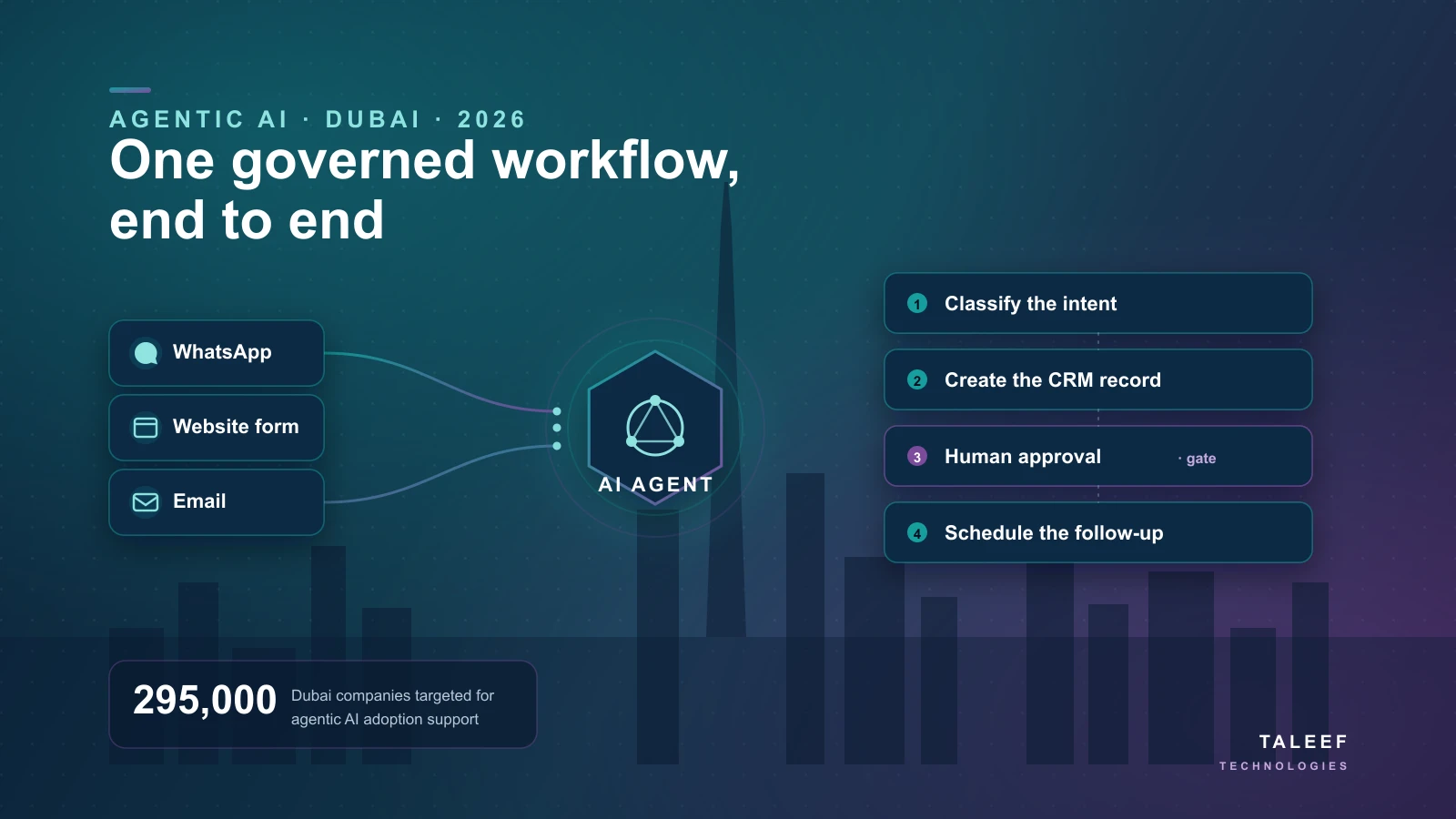
Agentic AI is software that takes a goal, decides which steps to run, and uses your connected business tools to finish a multi-step job, with limits you set. For a Dubai company that might mean reading a Click-to-WhatsApp enquiry, creating a CRM record, assigning it to the right salesperson, drafting a first reply, and scheduling a follow-up, while a person still owns pricing and the actual conversation.
In June 2026 this stopped being a vendor talking point in Dubai and became government direction. A committee chaired by His Highness Sheikh Hamdan bin Mohammed bin Rashid Al Maktoum, Crown Prince of Dubai, approved a programme to move roughly 295,000 Dubai companies toward agentic AI, alongside 100 specialised AI assistants to be built over two years and support for 50 new agentic AI firms. It sits under the Dubai Economic Agenda (D33). (Fast Company Middle East, Arabian Business)
The announcement changes the context, not the engineering. A business still has to pick one workflow, connect it safely, and prove it works. This guide is the practical version of that: what the plan means for an SME, which workflow to hand over first, how to keep control, and where the common projects break.
The short answer: what should a Dubai SME do first?
- Pick one workflow that is frequent, rule-based, reversible, and already digital. For most firms that is lead response and CRM routing.
- Map how it actually happens today, including the messy exceptions, and record a baseline you can measure against.
- Run the agent in “recommend only” mode first, then give it authority one action at a time, keeping human approval on anything consequential.
- Measure outcomes, not activity. Response time, effort, error rate, and revenue movement, compared against the baseline.
Everything below expands these four points for the UAE context.
What Dubai’s agentic AI plan actually means for your business
The programme is a support-and-direction signal. It tells you where Dubai’s economy is heading, it will likely produce sector tools and assistance, and it makes “we’ll look at AI next year” a weaker position with partners and clients. It does not hand you a compliant, working agent, and it does not transfer responsibility for data handling, customer outcomes, or errors away from your business.
It also arrives on top of an already-moving base:
The UAE digital transformation market was estimated at around USD 1.82 billion in 2026 and is projected to roughly double by 2031, with SMEs the fastest-growing segment. (Mordor Intelligence) The reasonable read is not “adopt everything now.” It is that the cost of doing nothing is rising, and the safe move is to connect AI to one workflow that already matters.
Agentic AI vs chatbot vs workflow automation
These overlap and get used interchangeably in sales decks. They are not the same.
| System | What it does | Best use | Main limitation |
|---|---|---|---|
| Chatbot / AI assistant | Answers questions, holds a conversation, can hand off to a human | Website and WhatsApp first response, FAQ deflection, capturing enquiry details | Does not, by itself, complete work in your other systems |
| Workflow automation | Runs fixed if-this-then-that steps between tools | Stable, well-defined processes with few exceptions | Brittle when inputs vary; every edge case needs a new rule |
| Agentic AI | Interprets a goal, chooses steps, calls tools, handles some variation, escalates the rest | Multi-step workflows with judgement in the middle, e.g. triage then route then draft | Needs guardrails, good data, logging, and human approval on consequential actions |
Most useful SME deployments combine them: a chatbot as the front door, an agent doing the multi-step work behind it, and deterministic automation for the parts that genuinely are fixed rules. We covered the pattern in depth in AI agents for small business: 9 workflows to automate first.
The nine workflows worth automating first in a UAE SME
Ordered roughly from lowest to higher risk. Start at the top.
- Lead response and CRM routing. Acknowledge every enquiry immediately, collect missing details, create or update the contact, assign to the right person by territory or product, and set a follow-up task. Humans keep qualification, pricing, and the sales conversation. This is the highest-value first project for most Dubai firms and pairs directly with Taleef CRM.
- WhatsApp and inbox triage. Classify inbound messages across WhatsApp, Instagram, and email, tag intent, pull order or account context, and draft a first reply for a human to send. See WhatsApp CRM integration in Dubai for the architecture.
- Quote and proposal preparation. Assemble a draft quote from a rate card and the enquiry details, flag anything non-standard, and route it for approval. The salesperson reviews and sends.
- Internal knowledge retrieval. Answer staff questions from your own approved documents (policies, product specs, SOPs) with a citation, and say “not enough information” when it does not know.
- Appointment and site-visit scheduling. Offer slots, confirm, send reminders, and handle reschedules, with a clear path to a human for anything unusual.
- Reporting preparation. Gather figures from CRM, finance, and e-commerce into a draft weekly report. A person checks the numbers and adds interpretation.
- Order and delivery status updates. Answer “where is my order” from live data and proactively message on delays. Escalate refunds and complaints.
- Onboarding and document collection. Chase missing paperwork (trade licence copies, Emirates ID, signed terms), validate what comes back, and update the record.
- Renewal and re-engagement nudges. Spot contracts or subscriptions coming up for renewal and prompt the account owner with context.
Payments, contract execution, hiring decisions, credit decisions, and anything regulated stay off this list until the basics are proven and, where relevant, legally reviewed.
How to keep control: the guardrails that matter
Agentic AI fails badly when it has broad permissions and no oversight. Four controls do most of the work.
On data protection: consent where it is required, no collection of sensitive data the workflow does not need, retention limits, and a documented view of which vendors and models touch customer information. Compliance is a property of the specific setup you build, not of “AI” in general, and it has to hold in every market you serve.
A 30-day starting plan
Sector notes for the UAE
Expand a sector to see the first workflow and where the human line sits.
Real estate: qualify and route portal leads in seconds
Click-to-WhatsApp and property-portal leads are high volume and time-sensitive. An agent acknowledges the enquiry immediately, asks for budget, area, and move-in timing, creates the CRM record, and routes to the agent who covers that community.
Worked example: a Bayut lead arrives at 23:10 for a 2-bed in JVC. The agent replies within seconds, captures budget and viewing availability, tags it “hot, ready to view”, and assigns it to the JVC agent with a 09:00 follow-up task. Viewings, negotiation, and offers stay human.
Clinics and healthcare: scheduling and pre-visit admin
Scheduling, reminders, and pre-visit document collection are strong first workflows. Anything touching clinical information or advice needs stricter data handling and a clinician in the loop.
Worked example: a patient messages to book a dermatology consult. The agent offers slots, confirms, sends an insurance-document checklist, and files the responses against the appointment. It does not answer clinical questions; those route to a nurse.
Professional services: triage and proposal assembly
Enquiry triage, proposal assembly from templates, and renewal nudges save partner and manager time. Scope and fees stay with the engagement lead.
Worked example: an inbound asks for “VAT registration plus monthly bookkeeping”. The agent classifies it, pulls the matching service templates, drafts a scoped proposal with placeholder pricing, and routes it to the manager, who sets the fee and sends.
E-commerce and retail: order status and cart recovery
Order status, COD confirmation, and abandoned-cart follow-up on WhatsApp are well-defined. Refunds, disputes, and pricing stay with staff. Connect the store and the inbox first, per the WhatsApp CRM guide.
Worked example: a shopper abandons a cart worth AED 640. The agent waits 40 minutes, sends one WhatsApp nudge with the items and a COD option, and logs the outcome. A reply asking for a discount is handed to a human.
Contracting and fit-out: capture and document chasing
Enquiry capture, document chasing, and change-order preparation are repetitive and reversible. Approvals and commercial terms are not.
Worked example: a consultant requests a fit-out quote. The agent logs the enquiry, chases the missing drawings and trade licence copy, and prepares a change-order summary from the rate card for the project lead to price and approve.
Common mistakes to avoid
- Automating a broken process. Faster confusion is still confusion. Fix the workflow first.
- Building one giant agent. Several small, constrained agents are easier to test, secure, and improve than one that does everything.
- Granting broad permissions early. Minimum access, minimum authority, widened only on evidence.
- Feeding it stale knowledge. Give source documents owners and review dates.
- Hiding uncertainty. The agent should be able to say it does not have enough information rather than guess.
- Skipping exception design. Real UAE operations have multi-language messages, duplicate enquiries across channels, and system outages. Design for them.
- Measuring actions instead of outcomes. More automated steps is not the goal; better and faster work is.
- Removing people from relationship moments. Negotiation, complaints, empathy, and accountability stay human.
- Treating the Dubai programme as a compliance shortcut. It is direction and support, not a sign-off on your data handling.
Where to begin with Taleef
The right entry point depends on where the work is breaking now:
- Website visitors leaving without an answer: evaluate TaleefAIBot.
- Leads and follow-ups scattered across phones and spreadsheets: evaluate Taleef CRM.
- Conversations split across WhatsApp, Instagram, and email: evaluate TaleefChat.
- Staff re-entering the same data between tools: start with Technology Integration Solutions.
- A problem that spans several systems and teams: begin with the Business Automation & Integration solution.
The first conversation should identify one workflow, its baseline, and its approval boundary. The Dubai plan is a good reason to start now; it is not a reason to skip the mapping and measurement that make an agent safe.
Discuss an agentic AI workflow with Taleef →
Sources and research notes
- Fast Company Middle East: Dubai wants 295,000 companies to embrace the next wave of AI
- Arabian Business: Dubai to support 295,000 companies with agentic AI under new Sheikh Hamdan-backed plan
- PwC 29th CEO Survey: Middle East findings, 2026
- PwC Middle East: Workforce Hopes and Fears Survey, 2026
- Mordor Intelligence: UAE Digital Transformation Market
- Taleef: AI agents for small business, 9 workflows to automate first
- Taleef: WhatsApp CRM integration in Dubai, the complete 2026 guide
- Taleef: ChatGPT Ads guide, how they work and how to run them