AI & Automation
ChatGPT Ads in 2026: How They Work and How to Run Them, Now Live in India
Taleef Technologies Team · 2026-08-29
Platform rules, budgets, eligible markets, objectives, and restricted categories were last checked on 7 September 2026 against OpenAI's Help Center, its 10 August 2026 Ad Policies, the OpenAI Ads developer documentation, and September 2026 regional reporting (CNBC and Business Standard on India, Campaign Middle East and Communicate Online on the Middle East and North Africa rollout). OpenAI is revising this documentation almost daily and its own pages currently disagree in places, which is noted in the text. Confirm the current position in OpenAI's Help Center before you plan or build a campaign.
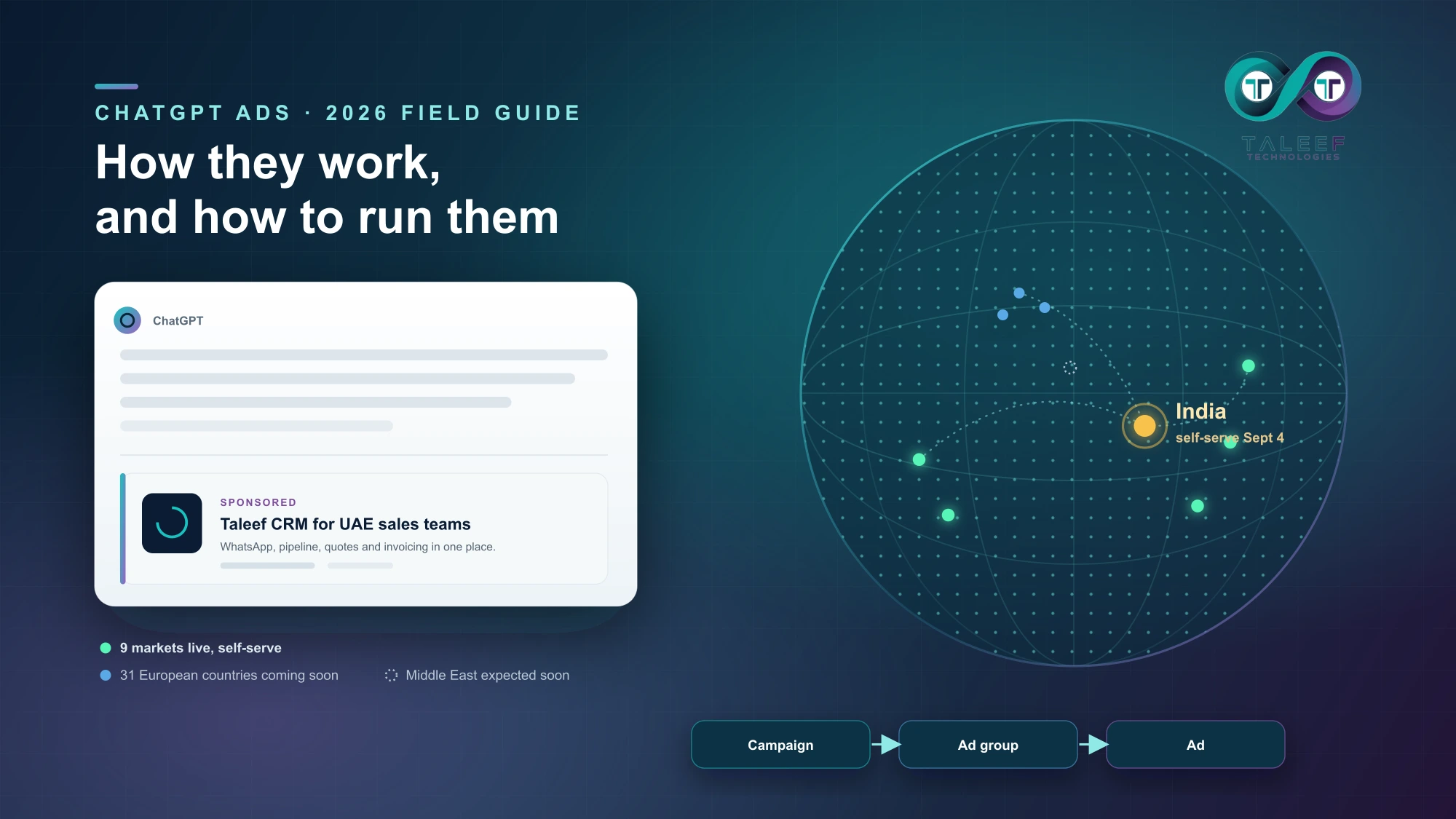
ChatGPT Ads are paid, clearly labelled placements that can appear beneath a ChatGPT answer when the conversation is commercially relevant. OpenAI’s self-serve Ads Manager now runs in its original nine markets plus India, where self-serve opened on 4 September 2026, and an early-September wave extended it to 11 markets across the Middle East and North Africa, though the UAE, Saudi Arabia, and Israel were left out. Thirty-one European countries are still marked as coming soon. (CNBC, Business Standard, Campaign Middle East, OpenAI Help Center)
The model is close enough to Google Ads that experienced buyers will recognise the structure, and different enough that copying a Google playbook will not work. This guide covers how the system works, how to build a campaign step by step, what it costs by market, and where the rules will catch you out.
The short version
- You can run ChatGPT Ads today if your business is in one of the original nine live markets, in India (self-serve since 4 September 2026), or in one of the 11 Middle East and North Africa markets added in early September. The UAE, Saudi Arabia, and Israel were excluded from that regional wave. Europe is still marked coming soon.
- The structure is Campaign, Ad group, Ad, with three buying types: CPM, CPC, and a conversion-optimised CPC.
- There is no keyword targeting. You describe the conversations you want with freeform “context hints” and let a relevance-weighted auction place the ad.
- You get aggregated performance data back, nothing more. No conversations, no trigger phrases.
- Some large categories are restricted, including financial services and health services outside the United States, and individual real estate and job listings everywhere.
What ChatGPT Ads are, and who sees them
A ChatGPT ad is a sponsored unit rendered below an answer, visually separated from the model’s response, showing your business name, logo, a headline, a short description, an image, and a “Sponsored” label. It is triggered by the topic of the conversation, so the intent signal sits closer to a search query than to a social feed.
Who can see it is narrow by design:
Where you can run ChatGPT Ads today
| Status | Markets |
|---|---|
| Live, self-serve | United States, United Kingdom, Canada, Australia, New Zealand, Japan, South Korea, Brazil, Mexico |
| Live, self-serve (new) | India (self-serve since 4 September 2026, after agency-led managed ads from 27 August); 11 Middle East and North Africa markets added in a late-August to early-September wave |
| Excluded from the MENA wave | United Arab Emirates, Saudi Arabia, Israel, not included as of 2 September 2026, with no published date |
| Coming soon | 31 European countries, including Germany, France, Italy, Spain, the Netherlands, Poland, and the Nordics |
If your market is not live, most of the setup work below still applies as preparation, and the organic and measurement groundwork transfers directly.
How to run a ChatGPT Ads campaign, step by step
How targeting actually works
The targeting model is the biggest departure from Google and Meta.
- Context hints, not keywords. You describe topics in plain language at the ad-group level. There is no exact-match keyword tool, and OpenAI does not promise your ad will appear in any specific conversation.
- No demographic targeting. There is no documented age, gender, or income targeting. Age signals exist only to keep ads away from under-18 accounts.
- Custom audiences need scale. Upload customer email addresses or phone numbers, hashed or raw, to build an audience of at least 25,000 matched users, with 100,000 or more recommended. Use them to include, exclude, or apply a bid multiplier.
- Geographic targeting goes to country everywhere, and to region or state, DMA, city, and postal code where supported. In the United States, state, DMA, and ZIP are available.
What you do not get back
- No conversation data. You never see the chats your ad appeared in or the phrases that triggered it.
- Aggregated reporting. OpenAI reports at account, campaign, ad group, and ad level, with breakdowns by country, device, and product, and click-through plus, where available, view-through conversions. It is more than country-level, but the conversation layer is invisible.
- Thin public benchmarks. The platform is weeks old outside the United States. Treat early third-party numbers with caution and measure against your own baseline.
Budgets and costs by market
Budgets are set as a daily or campaign-total amount. There is no separate lifetime minimum in OpenAI’s current documentation. Documented daily minimums include:
| Market | Daily minimum |
|---|---|
| United States | 25 USD |
| United Kingdom | 15 GBP |
| Canada | 25 CAD |
| Australia | 25 AUD |
| New Zealand | 25 NZD |
| Japan | 2,500 JPY |
| South Korea | 25,000 KRW |
| Brazil | 40 BRL |
| Mexico | 150 MXN |
| India | 725 INR |
For CPC campaigns, OpenAI’s guidance is to start around a 3 to 5 US-dollar maximum cost per click; this is advice, not a hard floor.
Restricted categories and sensitive contexts
Two separate limits apply.
Restricted advertiser categories. OpenAI’s Ad Policies, last updated 10 August 2026, disallow or restrict: adult content and dating, alcohol and tobacco, counterfeit goods, financial services, gambling, graphic sexual or violent content, health services, individual housing and job listings, legal services, political content, recreational drugs, scams and fraud, sensitive topics such as abortion, immigration, race, religion, and gender identity, and unsupported wellness claims. Financial services and health services have limited, case-by-case approval in the United States and are generally prohibited elsewhere. Categories allowed at launch are household and consumer goods, local services, travel and entertainment, and digital products and education. Baseline rules also ban misleading advertising and any imitation of the ChatGPT or OpenAI interface.
Sensitive conversation exclusions. Separate from your category, OpenAI withholds ads from a broad set of contexts. The consumer FAQ summarises these as personal health, mental health, and politics, but the formal policy is wider and includes child safety, self-harm, weapons, hate and harassment, misinformation, regulated goods, and “emotionally reliant” or “sensitive user journeys”. You cannot target your way back into any of them.
Privacy: what advertisers receive
OpenAI states that advertisers do not receive users’ chats, chat history, memories, names, email addresses, precise location, or IP addresses, and that it never sells user data to advertisers. What comes back is aggregated, non-identifying performance data plus the standard Ads Manager metrics. The one exception is that if a user chooses to message an advertiser directly through an ad, that advertiser sees those direct messages. This is a reasonable answer to give customers who ask whether their conversations are being sold: per OpenAI’s documentation, they are not.
ChatGPT Ads in India
India is OpenAI’s first large market outside the United States for ChatGPT Ads, and demand from Indian advertisers is already running ahead of the supply of reliable guidance.
What is live, and when
- 27 August 2026: managed, agency-led ads went live, with more than 50 brands intending to launch and WPP and Omnicom as OpenAI’s first India agency partners.
- 4 September 2026: the self-serve ChatGPT Ads Manager opened to Indian businesses as scheduled, so any verified company can now sign up and run campaigns directly.
- Ads reach logged-in adults on the Free and Go tiers. Go is priced at 399 rupees a month in India. Plus, Pro, Business, Enterprise, and Education users stay ad-free, and accounts identified as under 18 see no ads.
What ChatGPT Ads cost in India
The self-serve daily minimum is 725 rupees, roughly 7.60 US dollars, which is deliberately low enough for small businesses to test. You choose CPM, CPC, or conversion-optimised CPC as the buying type, and for click campaigns OpenAI suggests starting near a 3 to 5 US-dollar maximum cost per click. There is no separate lifetime minimum.
How an Indian business can start
Before 4 September the only route was an agency partner. Now the self-serve steps are the same as anywhere else: create and verify the account at ads.openai.com, add a billing profile and card, then build a campaign, an ad group with context hints, and an ad, and install the pixel or Conversions API before you launch. The full seven-step walkthrough above applies unchanged.
Why the timing matters
Search interest in “ChatGPT ads” and “how to run ChatGPT ads in India” has spiked since the announcement, while authoritative how-to content and real campaign data are still thin. Publishing accurate guidance and running early tests now, before the market crowds, is a genuine first-mover advantage for Indian businesses and the agencies serving them.
ChatGPT Ads in the UAE
ChatGPT Ads are not available to UAE advertisers as of 7 September 2026, and the position is now more specific than a simple absence from the roadmap.
What changed in early September
Between roughly 31 August and 2 September 2026, OpenAI extended the self-serve Ads Manager to 11 markets across the Middle East and North Africa. The UAE, Saudi Arabia, and Israel were explicitly excluded from that wave, with no published timeline for when, or whether, they will be added. So the accurate description is no longer “not listed” but “excluded from a regional rollout that has already shipped to neighbouring markets”. (Campaign Middle East, Communicate Online)
The local wrinkle that shrinks the audience
Even once ads reach the UAE, the addressable audience is narrower than headline usage suggests. Under the Stargate UAE arrangement, ChatGPT Plus has been made available free to UAE residents, and Plus users see no ads. Build any local forecast on the Free and Go population, not on total ChatGPT adoption in the country.
What UAE advertisers can do now
The preparation work transfers directly: generative engine optimisation so your business is cited in AI answers, landing pages and product feeds that hold up under a relevance-weighted auction, and attribution and CRM data clean enough to measure a channel that reports only in aggregate. Do it now so a UAE launch is a switch-on, not a standing start.
Other markets
Europe. Thirty-one countries are marked coming soon, including Germany, France, Italy, Spain, the Netherlands, Poland, and the Nordics. If you operate there, do the account preparation, landing-page, and feed work now so you can launch on day one rather than start from zero.
Rest of the Middle East and North Africa. The early-September wave reached 11 markets in the region. If you are in one of them, the standard seven-step setup applies; confirm your market is included in OpenAI’s Help Center before you commit budget.
How ChatGPT Ads fit alongside Google and Meta
Not as a replacement. The intent signal is strong, but the audience is capped to two tiers, the data you get back is thin, and independent results are still scarce. The realistic near-term case is incremental reach to people who are not actively searching, bought on a small budget, measured against a clear baseline, and scaled only where the numbers hold. Keep Google and Meta doing what they already do well.
Common mistakes to avoid
- Porting a Google keyword plan. There are no keywords here. Context hints are descriptions, and shorter, specific ones tend to work better than long prompts.
- Skipping measurement setup. With no conversation data and limited breakdowns, your pixel, Conversions API, and UTMs are the only way to know what worked.
- Budgeting for a restricted category. Financial services, health services, legal services, and individual property or job listings face hard limits. Confirm your sector before you plan spend.
- Forecasting on total ChatGPT usage. Only Free and Go users see ads, and in some markets free Plus access shrinks that further.
- Treating it as a channel to set and forget. OpenAI’s own documentation is changing weekly. Re-check the rules before each new campaign.
Where Taleef fits
Taleef works with companies inside and outside the currently live markets:
- In a live market, we set up the account structure, build and manage campaigns, wire up the pixel and Conversions API, and report against a baseline. We are added as a user on your ad account; OpenAI does not let agencies own the account.
- In a market that is not live yet, we do the work that transfers: generative engine optimisation so your business is cited in AI answers, landing pages and product feeds that hold up under a relevance-weighted auction, and attribution and CRM data clean enough to measure a channel that reports in aggregate.
Either way, the first conversation is about which market you are buying in, which category you are in, and what a realistic first test looks like.
Talk to Taleef about ChatGPT Ads →
Related reading
- Agentic AI for Dubai businesses: a 2026 adoption roadmap. Which AI workflows to automate first, and how to keep human control.
- AI agents for small business: 9 workflows to automate first.
- WhatsApp CRM integration in Dubai: the complete 2026 guide.
Sources and research notes
- OpenAI Help Center: ChatGPT Ads. The primary source; confirm current rules here before planning a campaign.
- OpenAI Ad Policies. Restricted categories and sensitive-context exclusions, last updated 10 August 2026.
- OpenAI Ads and OpenAI Ads developer documentation.
- CNBC: OpenAI rolls out ads on select ChatGPT plans in India.
- Exchange4media: OpenAI rolls out ChatGPT Ads in India.
- The Hans India: ChatGPT Ads arrive in India, OpenAI promises chats stay private.
- Search Engine Land: How to run ChatGPT ads, a step-by-step guide.
- Business Standard and CNBC (September 2026) on the completion of India’s self-serve ChatGPT Ads launch on 4 September 2026.
- Campaign Middle East and Communicate Online (September 2026) on the Middle East and North Africa self-serve expansion and the exclusion of the UAE, Saudi Arabia, and Israel as of 2 September 2026.