
Products
WhatsApp CRM Integration in Dubai: The Complete 2026 Guide to Capturing, Routing, and Converting Leads
Taleef Technologies Team · 2026-08-22
Product capabilities described here were checked on 22 August 2026. Confirm current scope with our team before committing to a workflow that depends on them.
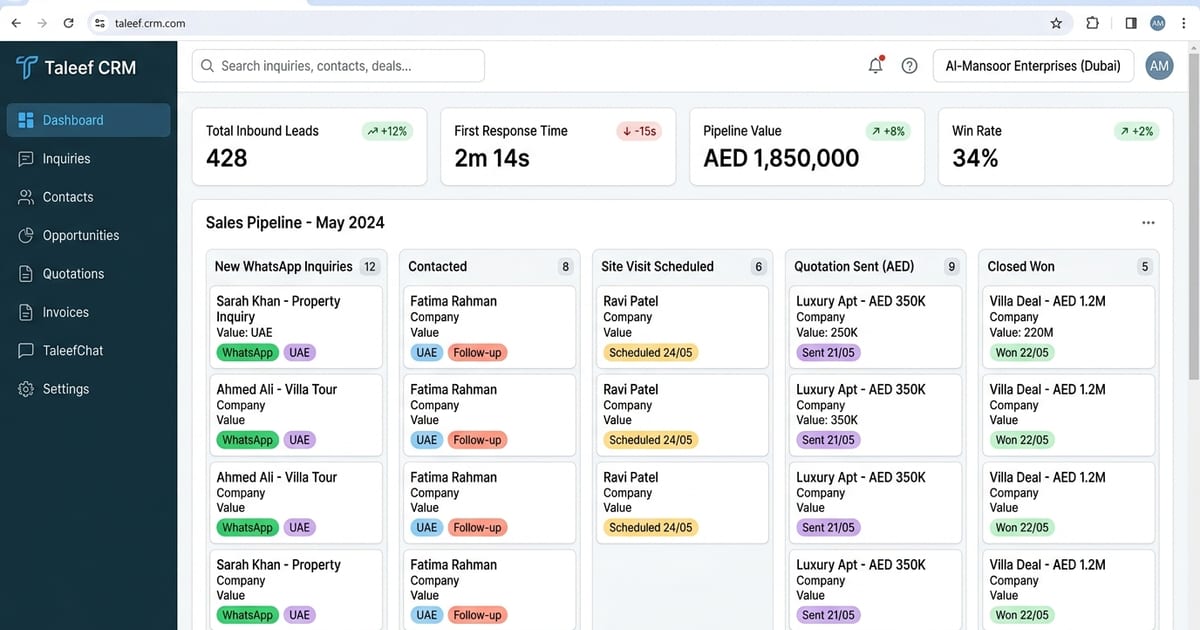
In the United Arab Emirates, WhatsApp is not an optional support widget, it is one of the primary channels customers use to reach a business. For commercial enterprises across Dubai, Abu Dhabi, Sharjah, and the free zones, high-value transactions, from real estate viewings and clinic consultations to corporate advisory work and ecommerce orders, routinely start inside a chat thread.
Yet most businesses in Dubai run into an invisible, costly operational bottleneck: the WhatsApp Lead Leak.
Enquiries arrive from Meta Click-to-WhatsApp ads, website floating buttons, Instagram direct messages, and Shopify stores, only to sit unanswered on personal employee phones, get lost in unorganized chat histories, or evaporate when a sales representative leaves the company.
This guide outlines how UAE organizations move from fragmented, personal chat apps to a centralized, multi-agent WhatsApp CRM setup. Grounded in real-world deployment across Taleef CRM, TaleefChat, and Technology Integration, it covers the workflows, privacy-conscious messaging practices, and sector-specific blueprints for turning conversations into tracked, closed-won revenue.
The UAE commercial landscape: why chat-first architecture wins
Customer communication in the Gulf Cooperation Council (GCC) has decoupled from traditional Western sales playbooks. In Dubai:
- Traditional email forms tend to run slow response times and low open rates. In high-velocity sectors, even a few hours’ delay can mean a prospect has already contacted a competitor.
- Cold telemarketing calls face restrictions and are increasingly filtered as spam by carriers and phones alike.
- WhatsApp conversations, by contrast, are widely reported to have high open rates and fast read times compared with email and cold calling.
Traditional disconnected funnel: Ad Click → Web Form → Email Ping (hours’ delay) → Unanswered Cold Call → High Lead Drop-off
Connected inbound engine: Ad/Web Click → WhatsApp Entry → Automated Inbound Capture → Fast Rep Assignment → Higher Conversion
Whether a buyer is enquiring about a property in Dubai Marina, booking a clinic consultation in Jumeirah, scheduling a corporate advisory session in DIFC, or confirming an order on Shopify, they expect a conversational response in their preferred language (Arabic or English).
Operational reality: Generating leads is rarely the hardest part for UAE businesses. The harder part is operational continuity, making sure high-intent conversations are captured, assigned, tracked, and followed up inside a system everyone can see.
The 7 costly symptoms of the “WhatsApp Lead Leak”
Before scaling paid ad spend on Meta or Google, evaluate your customer journey against these seven common operational vulnerabilities.
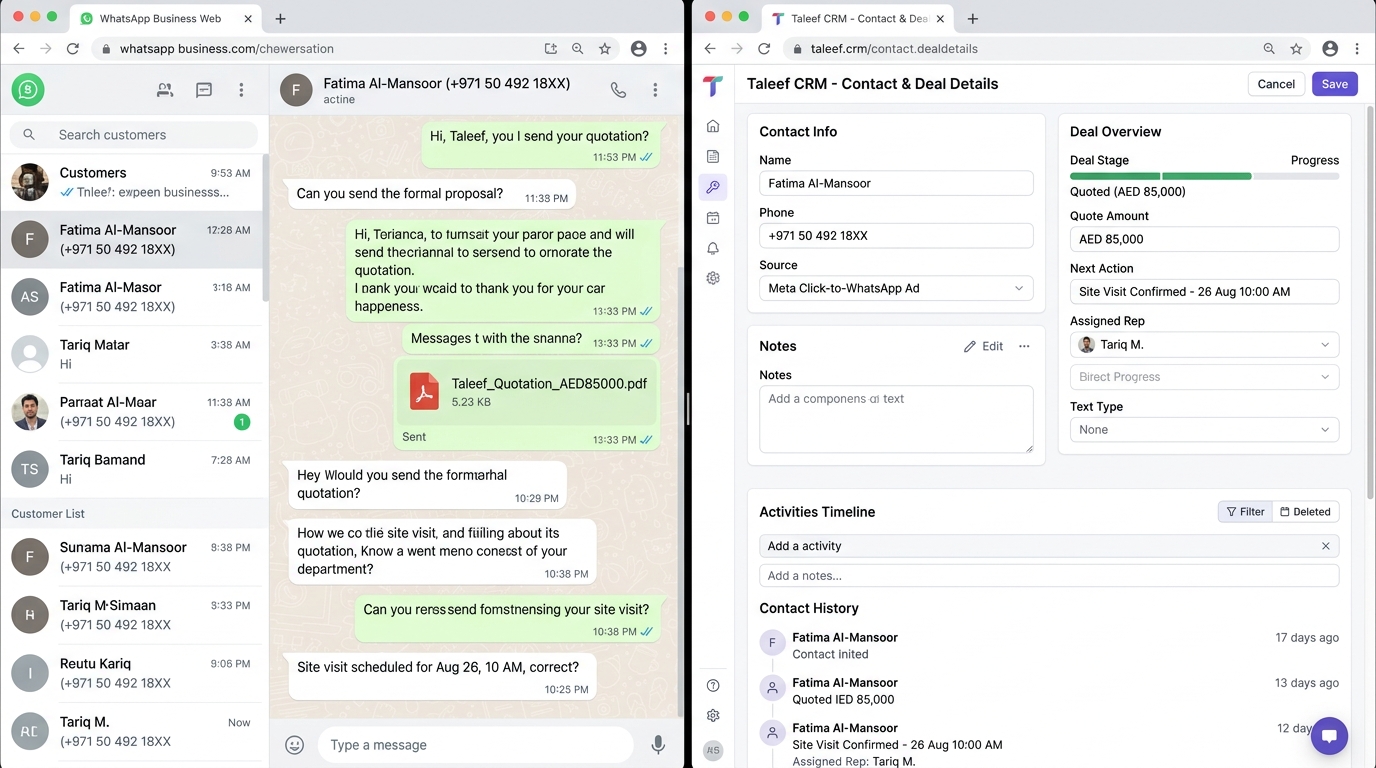
wa.me/971... phone link. Management has no visibility into which campaign or ad creative generated paying clients versus unqualified chats.info@ email; Instagram DMs stay in the mobile app; WhatsApp chats sit on phones. Sales reps lose time context-switching across tools without a single customer timeline.Taleef CRM architectural blueprint: from inbound hook to cash
A working WhatsApp CRM integration is not just a chat widget. It is an operational pipeline connecting customer acquisition through to invoicing.
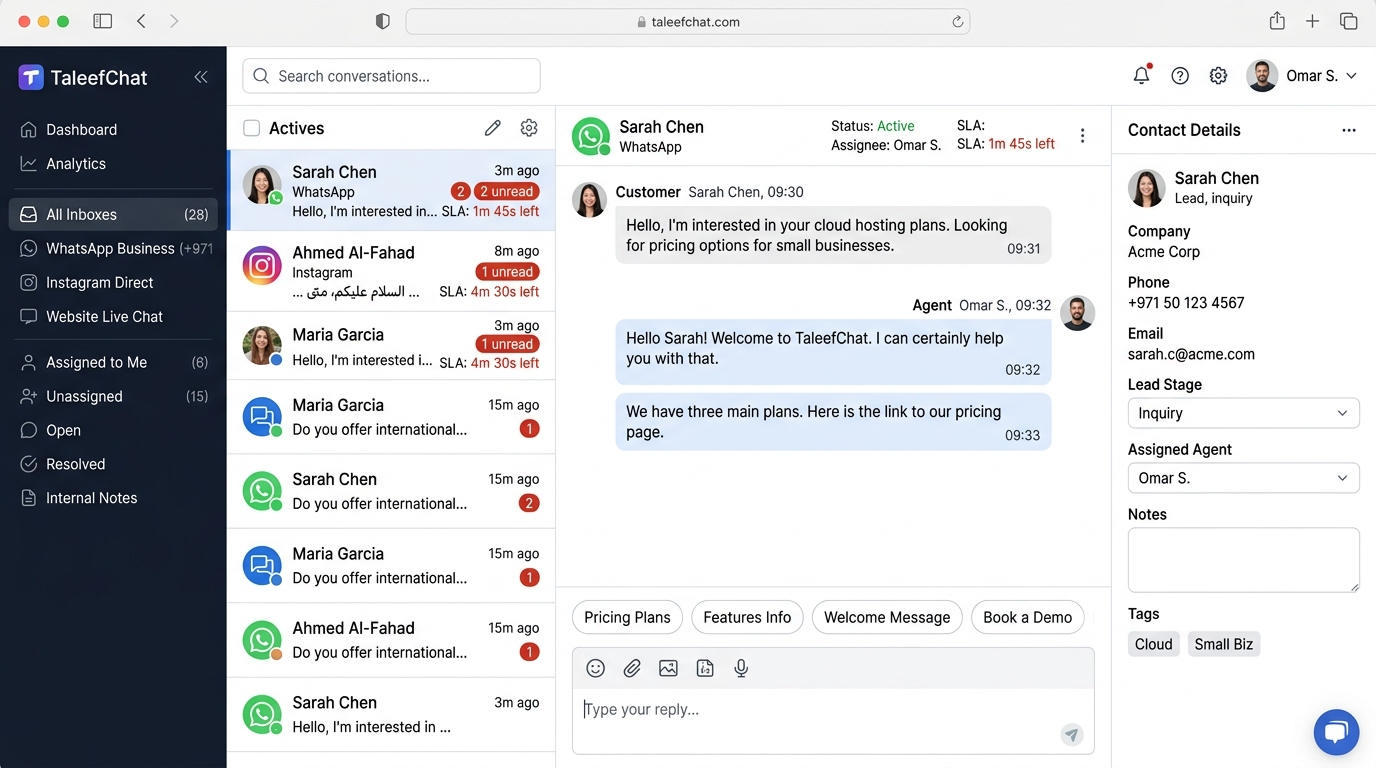
Here is how the data flows through the Taleef CRM & TaleefChat stack:
- Inbound traffic & entry points: Meta Click-to-WhatsApp ads, website contextual forms & TaleefAIBot conversations, Instagram direct messages, Shopify/ecommerce order events (via Technology Integration), and QR codes (exhibitions, print, in-store).
- Orchestration & ingestion: Meta Cloud API / WhatsApp Business Platform, webhook listener, round-robin dispatcher.
- Taleef CRM core engine: inbound inquiry capture, contact & account profile, opportunity & stage tracking, site visit scheduling, automated follow-up tasks, quotations.
- Revenue & backoffice conversion: quotation-to-invoice conversion, reporting & audit logs.
Key capabilities in the integration:
- Inquiry capture: ingests multi-channel inquiries with source attribution, product interest category, and contact details before qualification.
- Contacts & accounts: stores unified customer profiles with chat logs, activity history, and documents.
- Opportunities: manages customizable sales stages (New, Contacted, Qualified, Proposal Sent, Negotiation, Closed-Won) with AED deal values.
- Site visits: coordinates property viewings, showroom visits, and on-site consultations directly from chat interactions.
- Quotations & invoices: generates quotations that carry through to invoices without re-entry. VAT handling, accounting-system sync, and payment gateway checkout depend on the specific integration scoped for your business, confirm current support with our team before committing to a workflow that depends on it.
Platform comparison: WhatsApp app vs. Cloud API vs. integrated CRM
Selecting the right technology tier helps your systems scale without operational roadblocks.
| Feature / Capability | WhatsApp Business App | WhatsApp Business Platform (API) | Taleef Integrated CRM Suite |
|---|---|---|---|
| Target Organization | Freelancers & Solo Ops | Technical Developer Teams | Scaling SMEs & Enterprises |
| Concurrent Users | Max 4 linked devices | Unlimited (requires custom UI) | Multi-agent shared inbox |
| CRM Contact Sync | Manual copy-paste | Requires webhook engineering | Automatic 2-way sync |
| Inquiry Ingestion | None | Raw JSON payloads | Auto-creates Inquiries & Contacts |
| Ad Attribution (Meta CTWA) | None (Blind chats) | Webhook payload support | Campaign, Ad ID & UTM capture |
| Line-Item Quoting | None | Not supported | Quotation & invoice creation |
| Site Visit Scheduling | Manual calendar app | Not supported | Integrated calendar & field dispatch |
| Automated Follow-Up Reminders | None | Custom backend script | Automated SLA alerts & task triggers |
| Tenant Isolation & Security | Local device storage | Cloud API | Multi-tenant data governance |
Omnichannel synchronization
A working system unifies customer channels into one clear operational workflow.
1. WhatsApp + website inquiries
Website forms and WhatsApp should reinforce each other:
- Context-aware pre-filled prompts: when a visitor clicks a WhatsApp button on a specific service page (for example
/services/technology-integration/), pre-populate the chat prompt with service context:https://wa.me/97150XXXXXXX?text=Hi%20Taleef,%20I%20am%20inquiring%20about%20Technology%20Integration%20services. - Instant webhook ingestion: when a visitor submits a quote request web form, the system automatically creates an inquiry record and can trigger an automated WhatsApp confirmation, for example:
Thank you for contacting Taleef, [Name]. Your inquiry has been assigned to our team. Would you like to review our technical overview while we review your scope?
2. WhatsApp + paid Meta ads (Click-to-WhatsApp attribution)
For Dubai brands investing in Meta Ads (Instagram & Facebook):
- Ad attribution ingestion: TaleefChat captures the Meta referral data (ad and campaign identifiers) that Click-to-WhatsApp ads pass into the conversation, attached to the inbound message.
- Closing the loop to revenue: carrying that attribution through the CRM pipeline, so a closed AED deal traces back to the originating ad creative, is a Technology Integration build, not a default connection today. Scope it with our team before assuming it’s live.
- Actionable optimization: once wired up, performance marketing teams can use this to identify which ad variations generate closed deals rather than just chat clicks.
3. WhatsApp + Shopify & UAE ecommerce automation
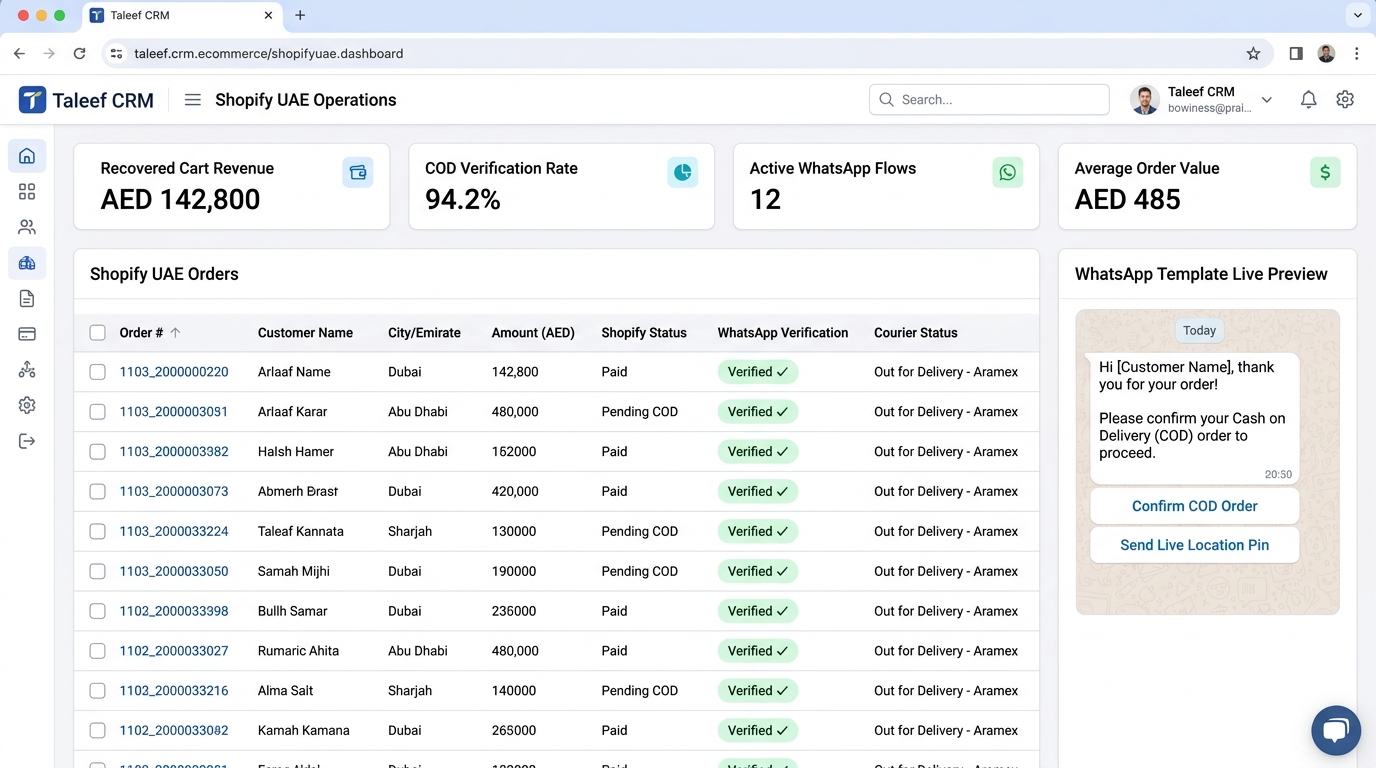
For UAE ecommerce brands operating on Shopify or custom storefronts, TaleefChat connects directly to Shopify to bring order and customer data into the same shared inbox agents already use for WhatsApp:
- Order & customer sync: Shopify orders and customer records sync into TaleefChat, so an agent replying to a WhatsApp message can see the shopper’s order history without switching tools.
- Side-panel customer view: when a shopper messages support, agents can see order and purchase context directly inside the same conversation view.
- COD verification, abandoned-cart recovery, and courier tracking over WhatsApp: these are workflows we can build on top of the Shopify connection via Technology Integration, they are not a default, out-of-the-box feature. Scope them with our team before assuming they are live for your store.
Speed-to-lead routing and automated follow-ups
Response speed is consistently linked to conversion in sales research generally. Taleef CRM supports this through two mechanisms:
Intelligent inbound routing: an inbound message is checked against business hours. During business hours it goes through round-robin assignment to an available rep; outside business hours it can trigger an automated greeting and TaleefAIBot requirement capture instead.
- Interactive department filters: quick-reply buttons route chats to specialized team queues: 1. Sales & New Proposals2. Active Project Support3. Billing & Invoices
- SLA breach alerts: TaleefChat’s SLA policies flag a conversation when a reply takes longer than the configured window, so it doesn’t sit unnoticed. Bilingual (Arabic/English) team routing and automatic reassignment to a backup rep are things we can configure for your team via Technology Integration, they aren’t a default behavior, confirm scope before relying on them.
Follow-up tracking: most deals need multiple touchpoints before closing. Taleef CRM surfaces quotations that are missing a follow-up so a rep can act on them, rather than losing them to an inbox. A team can build a cadence around this, for example:
Hi [Name], just confirming you received the proposal document sent to your email. Please let me know if you have any questions on the scope.
Hi [Name], our team has a deployment window available for next week. Would you like to schedule a briefing call?
Hi [Name], should we keep this quotation active for your team, or has this requirement been postponed?
Sending these on a fixed timer automatically is a workflow we’d scope and build, it isn’t a default, out-of-the-box trigger.
Handling customer communications responsibly
Good WhatsApp CRM practice comes down to a few habits that protect both the customer relationship and the number itself:
- Consent & privacy: explicit customer consent before marketing outreach, a clear and easy opt-out path (reply “STOP” / “الغاء”), and secure, role-restricted customer data storage.
- Respectful outreach: no unsolicited spam broadcasts, no messaging numbers scraped from directories or lists you don’t own, and marketing outreach generally kept within business hours.
- Meta WhatsApp Business Policy: business-initiated messages require pre-approved templates, with a documented opt-in record attached to the customer profile.
Practical rules worth following:
- Never message scraped contact lists. Sending unsolicited broadcasts to numbers scraped from business directories violates Meta’s policies and risks a permanent number ban.
- Document explicit opt-ins. Website forms and ecommerce checkouts should include clear consent language, for example: “I agree to receive project updates and proposals via WhatsApp.”
- Process opt-outs automatically. Configure the CRM to mark contacts as Do Not Contact when they reply with keywords like “STOP”, “UNSUBSCRIBE”, or “الغاء الاشتراك”.
This is general good practice, not legal advice. Confirm your specific setup against current requirements before relying on it as compliant.
Sector-specific implementation patterns
- Challenge
- High ad spend on Meta and property portals, international investors across time zones, delayed broker follow-ups.
- Approach
- Inbound WhatsApp leads are qualified by TaleefAIBot (budget range, preferred community, payment plan preference), then qualified buyers are scheduled for a site inspection or virtual walkthrough with an assigned broker, tracked inside the CRM.
- What this targets
- Faster, more consistent follow-up on inbound property enquiries so fewer qualified buyers go cold waiting for a callback.
- Challenge
- Consultation no-show rates, multilingual patient scheduling (Arabic, English, Russian).
- Approach
- WhatsApp CRM connects to clinic scheduling. Patients can receive automated appointment reminders with confirmation or rescheduling options, clinic location links, and pre-treatment instructions.
- What this targets
- Fewer missed appointments by making confirmation and rescheduling a one-tap action inside the same chat thread.
- Challenge
- Complex service scopes, long sales cycles, multiple decision-makers.
- Approach
- A website visitor clicks WhatsApp on a free zone license or advisory page; the CRM captures business activity and requirements, and assigns a senior consultant to follow up with a scoped quotation.
- What this targets
- A single traceable record of the negotiation instead of scattered chats, emails, and verbal commitments.
- Challenge
- Cart abandonment, delivery address ambiguity in newly developed UAE communities, manual customer care workload.
- Approach
- Shopify order and customer data synced into TaleefChat's shared inbox, so support agents handle WhatsApp conversations with full order context, with abandoned-cart and courier-dispatch messaging scoped as a Technology Integration build on top of that connection.
- What this targets
- Fewer customer-care conversations starting from scratch, and a foundation to build recovery workflows on.
Metrics worth tracking
To evaluate the impact of your integration, track these indicators against your own baseline, before and after rollout, rather than an external benchmark.
| Indicator | What it tells you |
|---|---|
| First Response Time (FRT) | How fast a new inquiry gets a reply |
| Lead-to-Conversation Rate | Share of ad clicks that start a chat |
| Inbound Inquiry-to-Opportunity | Share of inquiries that qualify |
| Quotation-to-Invoice Cycle Time | How long deals take to close and bill |
| Follow-Up Overdue Rate | Share of pipeline missing a next step |
| Customer Satisfaction (CSAT) | Post-chat feedback, if collected |
| Return on Ad Spend (ROAS) by Ad | Closed AED revenue by ad source |
| Opt-Out / Unsubscribe Rate | How often contacts opt out |
A 30-day phased rollout
How Taleef helps UAE businesses build connected revenue systems
- Taleef CRM: sales pipeline, inquiries, site visits, quotations, and invoicing in one platform.
- TaleefChat: multi-agent shared inbox unifying WhatsApp, Instagram, website chat, and email.
- TaleefAIBot: conversational AI that qualifies website visitors and hands off leads into your CRM.
- Taleef ChangeLink: capture scope change approvals via WhatsApp voice notes or photos.
- Technology Integration Services: custom API connectors, ERP sync, and webhook automation.
- Website & Ecommerce Development: conversion-focused web platforms and Shopify stores with conversational triggers.
- Digital Marketing & SEO: performance marketing campaigns aimed at measurable closed-won revenue.
Taleef helps connect approved WhatsApp entry points, customer messaging, CRM, website forms, ecommerce, and reporting workflows using the customer’s selected Meta Business setup, CRM, and messaging providers.
If your sales team is managing high-intent customer conversations across scattered mobile phones, every day of delay is lost revenue.
Request a WhatsApp-to-CRM Workflow Audit →
Related reading
- Agentic AI for Dubai businesses: a 2026 adoption roadmap. Once the pipeline is connected, which conversation workflows to hand to an AI agent first, and where the human line sits.
- AI agents for small business: 9 workflows to automate first
- ChatGPT Ads guide 2026: how they work and how to run them